AI demand will keep rising, just not fast enough to pay for the build-out
Demand for AI computing will keep rising for years, but it is likely to arrive later than the data centres being built for it need. Before AI can do much of a company's work, the company has to rebuild how that work gets done, and that is slow. The chips and the debt paying for the build-out run on a much shorter clock.
The case for the build-out rests on how much computing AI will use. Some of it goes into training new models, and some into running them each time someone asks a question or sets an agent off on a task. Epoch AI estimates OpenAI's computing in 2025 was split roughly evenly between the two. Training is paid for once per model, while running costs grow with every use, so the growth has to come from use.
Use depends on how much work agents end up doing, and that depends on how work gets done today. Most of it still runs through people. Someone sends an email or makes a call, and another person reads it and acts. Whole processes are built around that.
Agents will start by working inside that system, filling in forms and writing emails. That takes a lot of computing, because the agent reads documents written for people and writes things another person or agent then has to read.
Later, systems get rebuilt around agents. If both sides of a task have one, nobody needs the email, because the software can talk directly and the same work takes far less computing. In one Anthropic example, a task needed 98.7% less once the agent worked with its tools directly.
Computing per task should rise first and then fall. Almost nothing has been rebuilt around agents yet, so most agent work today is the expensive version, and demand is still in the rising phase.
How long that lasts depends on how fast companies rebuild, and they are moving slowly. Only about one US business in five uses AI, and even among the largest firms the share is 37%. Companies that do build Anthropic's Claude into their own systems mostly hand it whole tasks, with 77% of that use looking like automation. Anthropic found cost matters little in how they use it. What holds them back is getting the model the information it needs. In most companies that information is scattered across inboxes and old systems, and Anthropic says pulling it together may need "costly restructuring". That takes years.
A slow rebuild matters because the build-out assumes a lot of use soon. J.P. Morgan Asset Management estimates the industry needs about $650bn of revenue a year for a 10% return on what has been invested, or $35 a month from every iPhone user. Bain looks further out. It reckons AI revenue has to reach about $6tn a year by 2031 to fund the spending, and that consumers and businesses will spend $1.2tn to $1.8tn on today's uses by then. The rest has to come from products that barely exist yet, such as robots and AI-run scientific research.
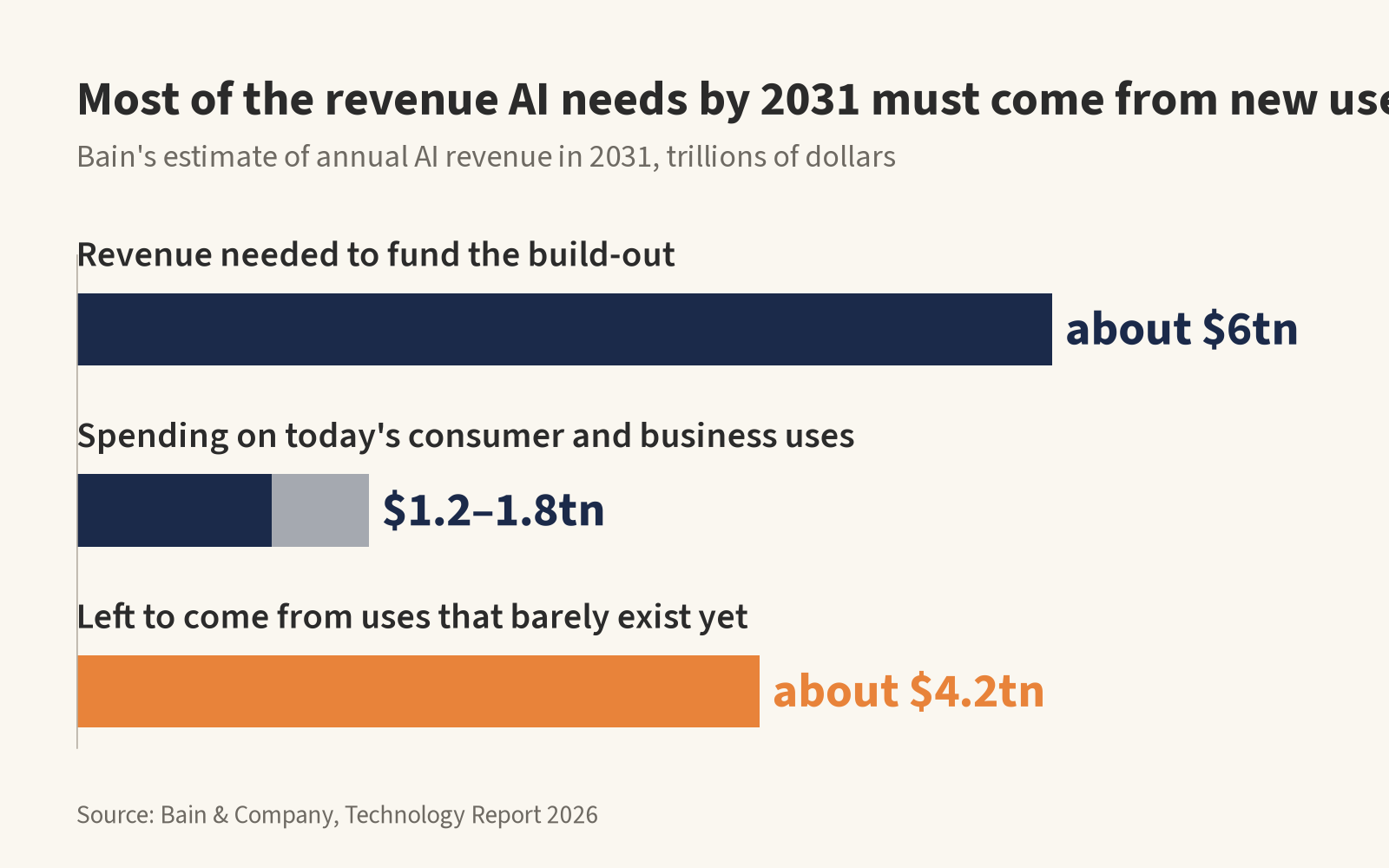
Forecasts of how fast office work changes point the same way. Goldman expects only 12% of knowledge workers to be using agents by 2030. On that pace, most office work will still run the old way when Bain's deadline arrives. J.P. Morgan's lower bar looks reachable. Bain's needs far more of the economy to change within five years than companies are managing.
That is how demand can keep rising and still come too late. Data-centre chips are written off over about five years, and Amazon cut the assumed life of its servers from six years to five. Much of the debt funding the build-out runs on a similar clock. The companies meant to pay for it move more slowly, because they have to rebuild first. If their spending arrives several years late, most of the chips will already be written off and much of the debt will have come due.