Private equity is rebuilding its funds rather than cutting its prices
Private equity firms are holding on to companies they can't sell at the values on their books, and they are building new kinds of fund to do it. Each new structure gives some investors a way out. The ones who stay end up holding older companies for longer, and the industry's own research shows that returns stall the longer a company is held.
The strain shows up in the cash going back to investors. Buyout firms used to sell a company after five or six years, and they now hold for close to seven. Bain says payouts to investors have lagged their historical average for four years running. Last year they came to 14% of fund value, a level last seen in 2008 and 2009. About 32,000 companies are still waiting to be sold, worth $3.8tn.
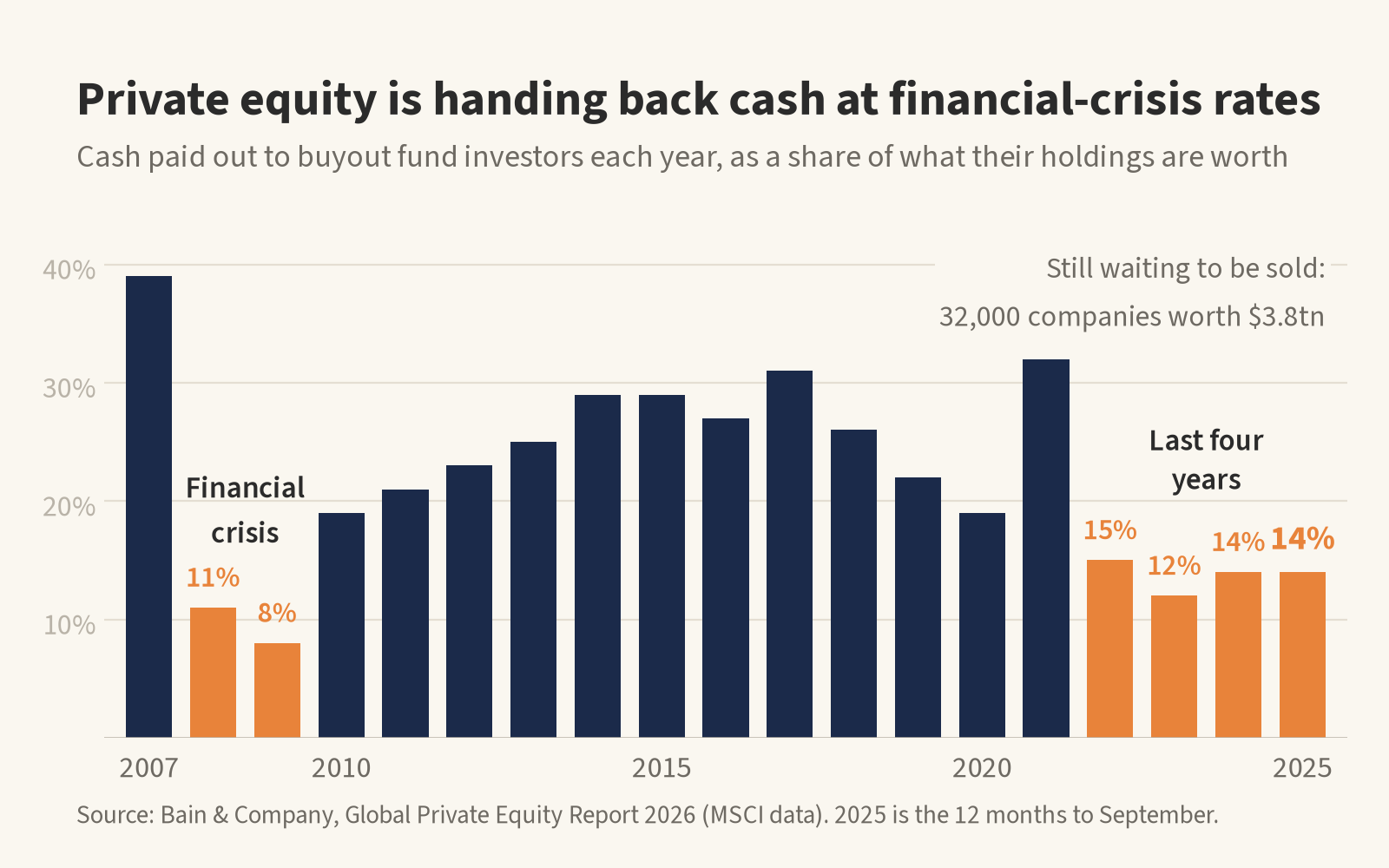
Interest rates are the main reason. Many of these companies were bought in 2021 and 2022, when debt was cheap and expected to stay cheap. Ten-year US government bonds now yield above 5%. A buyer who can earn that from the US government will not pay a 2021 price for a company growing more slowly than planned. The seller doesn't want to take less than the book value, because that would show the book value was too high.
Instead of cutting prices, the industry has built ways to hold for longer. The most common is the continuation fund. A manager sells a company from an old fund to a new one it also runs, and investors in the old fund can take cash or roll into the new one. These were a niche tool a few years ago, and 82 of the top 100 sponsors have now used one. A typical continuation fund lasts five years with two one-year extensions. Goldman and Evercore are now pitching "forever" versions that could hold a company for 10 to 15 years.
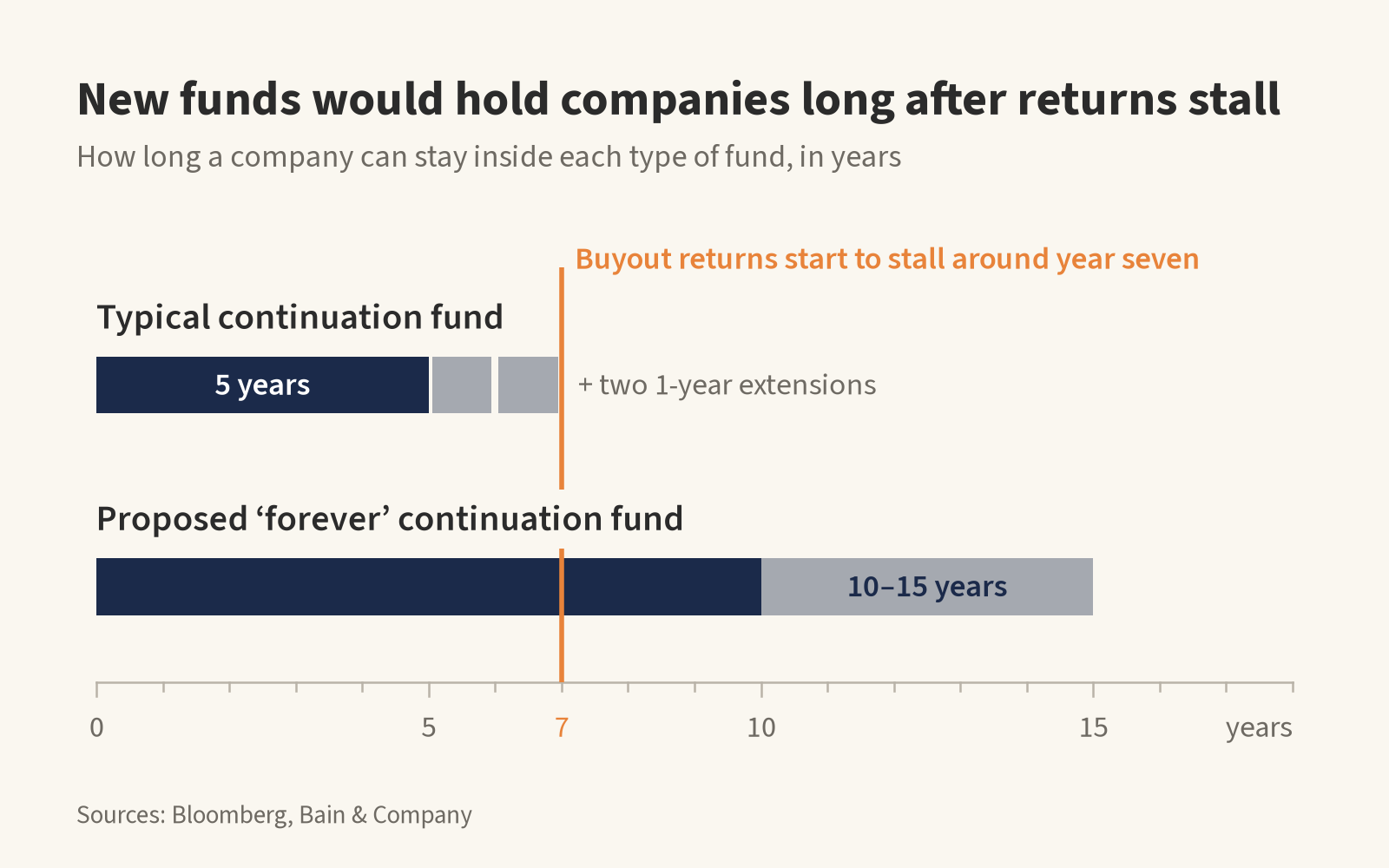
That runs well past the point where returns fade. Bain finds buyout returns start to stall around year seven. A fund built to hold for 15 years is betting its companies are the exception. Bloomberg reports that the idea is at an early stage, with open questions over how the manager's share of profits would work and how often investors could get out.
The same approach is now reaching funds sold to private clients. Partners Group's €6.6bn Global Value fund lets investors withdraw each quarter. After requests reached an estimated 9.8% of the fund in the second quarter, it capped withdrawals at 5%. Its plan is to split the fund in two. One part would hold the older companies, which Bloomberg describes as the weaker performers, and pay out cash as they are sold. The other keeps the rest and takes new money, including Partners Group's own. Investors vote in the week of 9 November, and the firm is cutting fees to win their support.
Those fee cuts are what the investors who stay get in return. Anyone who wants out now can wait in the queue or sell their stake to another investor, and buyout fund stakes have been selling for about 91% of their reported value. Leaving that way costs about 9% of the money. Staying in the older half earns a fee cut of at least a quarter of a percentage point a year for three years, and a longer wait. The manager chooses which companies go into each half and earns fees on both. A quarter point a year is small next to a wait that could run for years.
Who is waiting matters beyond the industry. Pension funds use these payouts to pay pensions. Wealthy clients bought funds like Partners Group's expecting to get out roughly every quarter, and Blackstone alone manages $330bn of private wealth money.
Each new structure moves the wait onto a different group of investors without testing the price. Until managers sell more of the companies bought at the top for what buyers will actually pay, the investors who stay are the ones paying for the delay.