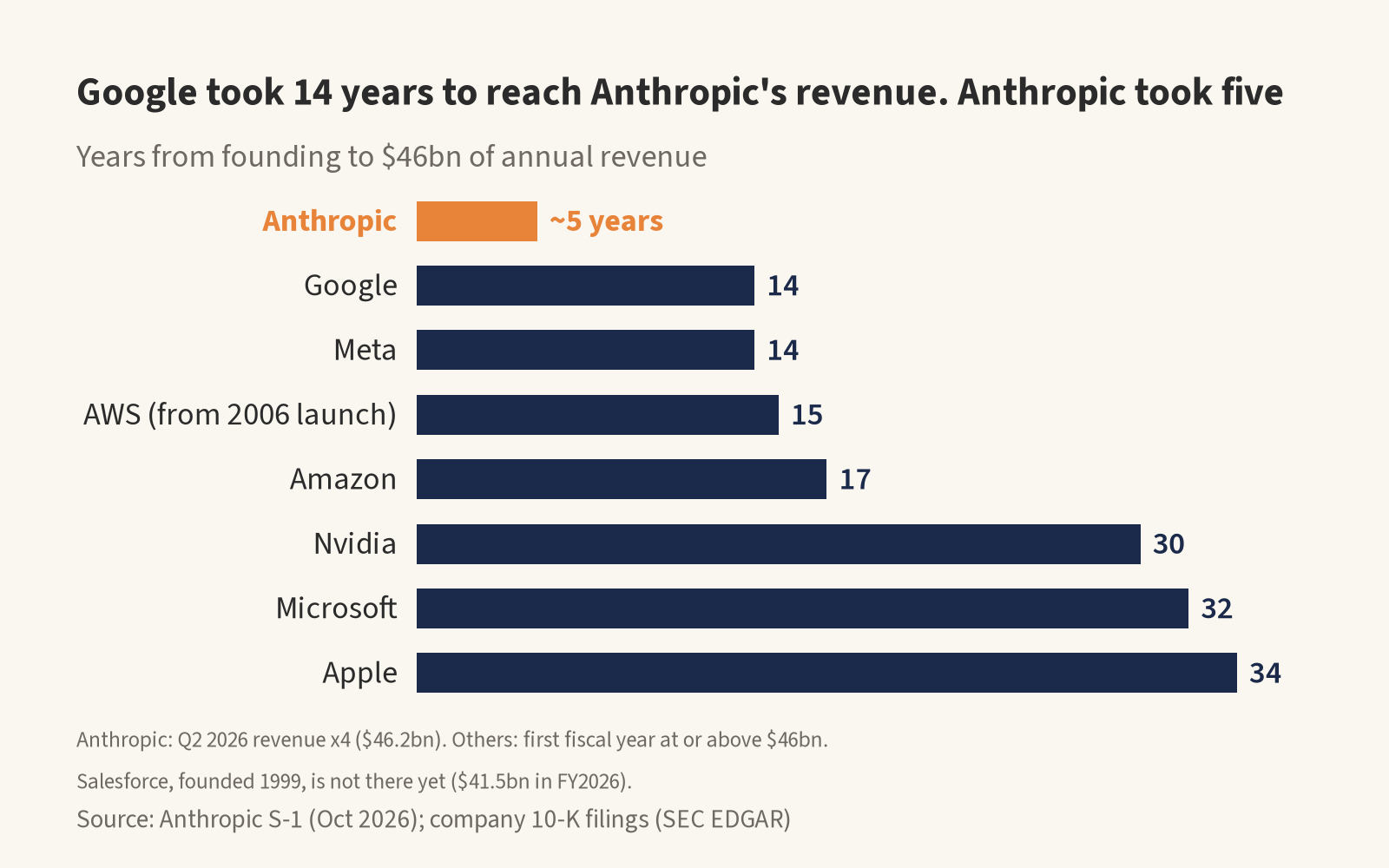
Anthropic reached Google's size in a third of the time
Anthropic reached $46bn of annualised revenue about five years after it was founded. Google took 14 years to get there. Its prospectus, filed on 26 October, shows a business still growing fast and now earning cash. The reported listing price of $1.5tn to $2tn assumes that pace carries on.
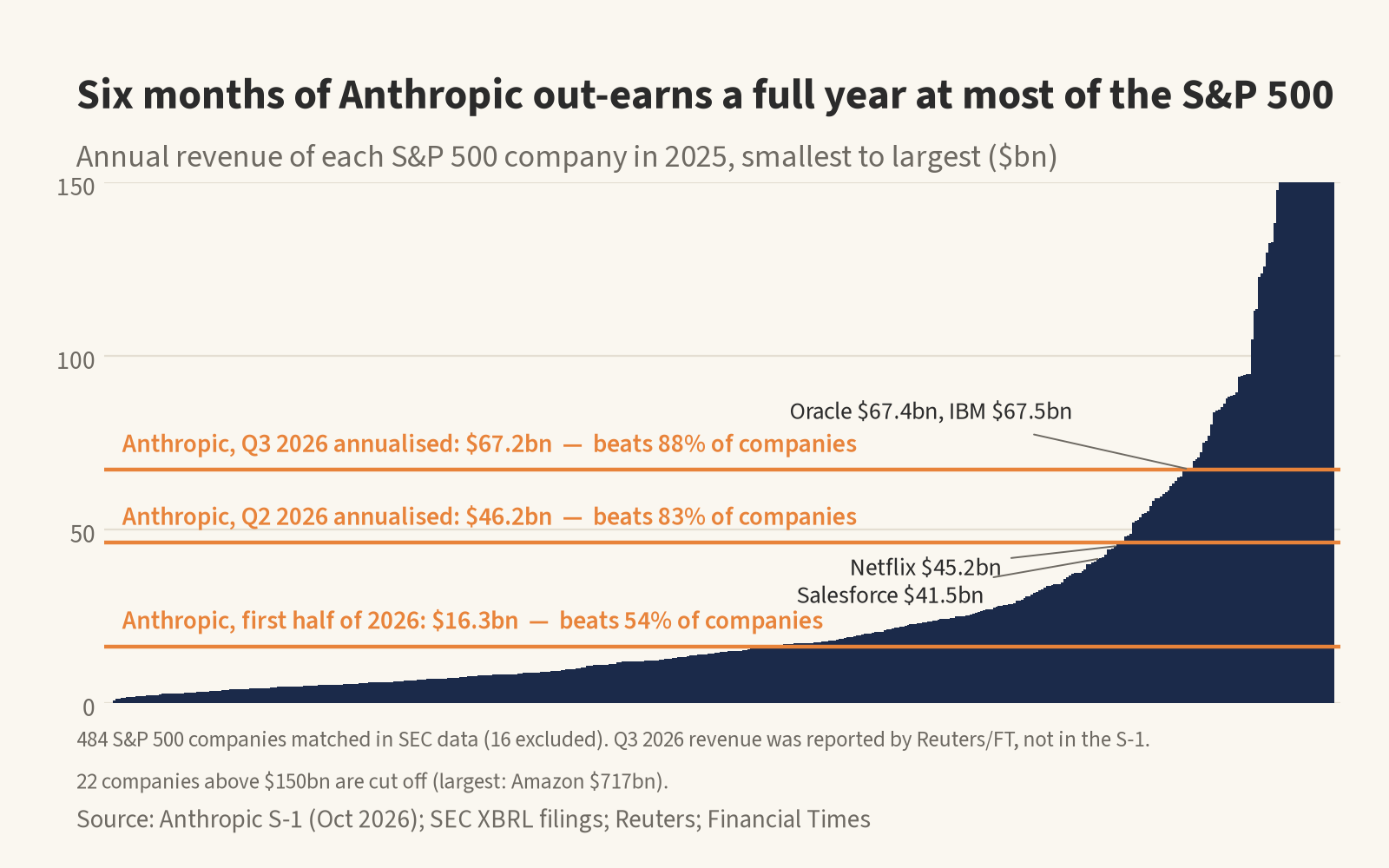
Anthropic has since told investors it earned $16.8bn in the third quarter, according to the Financial Times, a run rate of about $67bn a year. That beats the annual revenue of about 88% of S&P 500 companies and is about the same as Oracle or IBM.
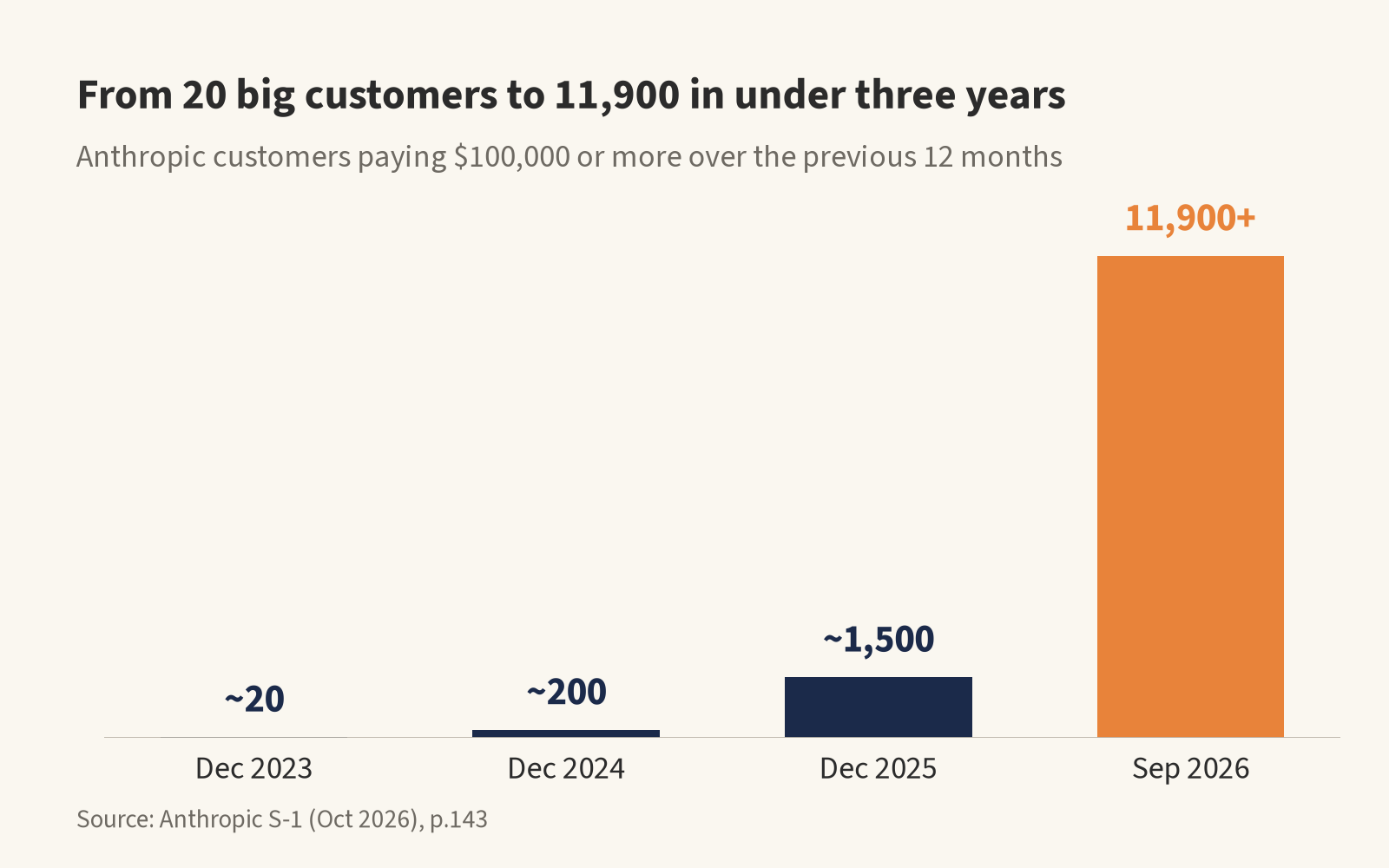
Most of that revenue comes from businesses, and the prospectus counts those paying $100,000 or more a year. There were about 20 at the end of 2023 and about 200 a year later. By the end of 2025 there were about 1,500. By September 2026 the number passed 11,900, roughly eight times as many in nine months, so growth is speeding up.
These customers still spend very little with Anthropic. The prospectus says its revenue from its Fortune 500 customers is, on average, less than 0.1% of their total expenses. Smaller US businesses already put about 5.8% of their spending outside payroll into AI, according to the Ramp AI Index. That gap leaves Anthropic years of growth inside companies that already pay it.
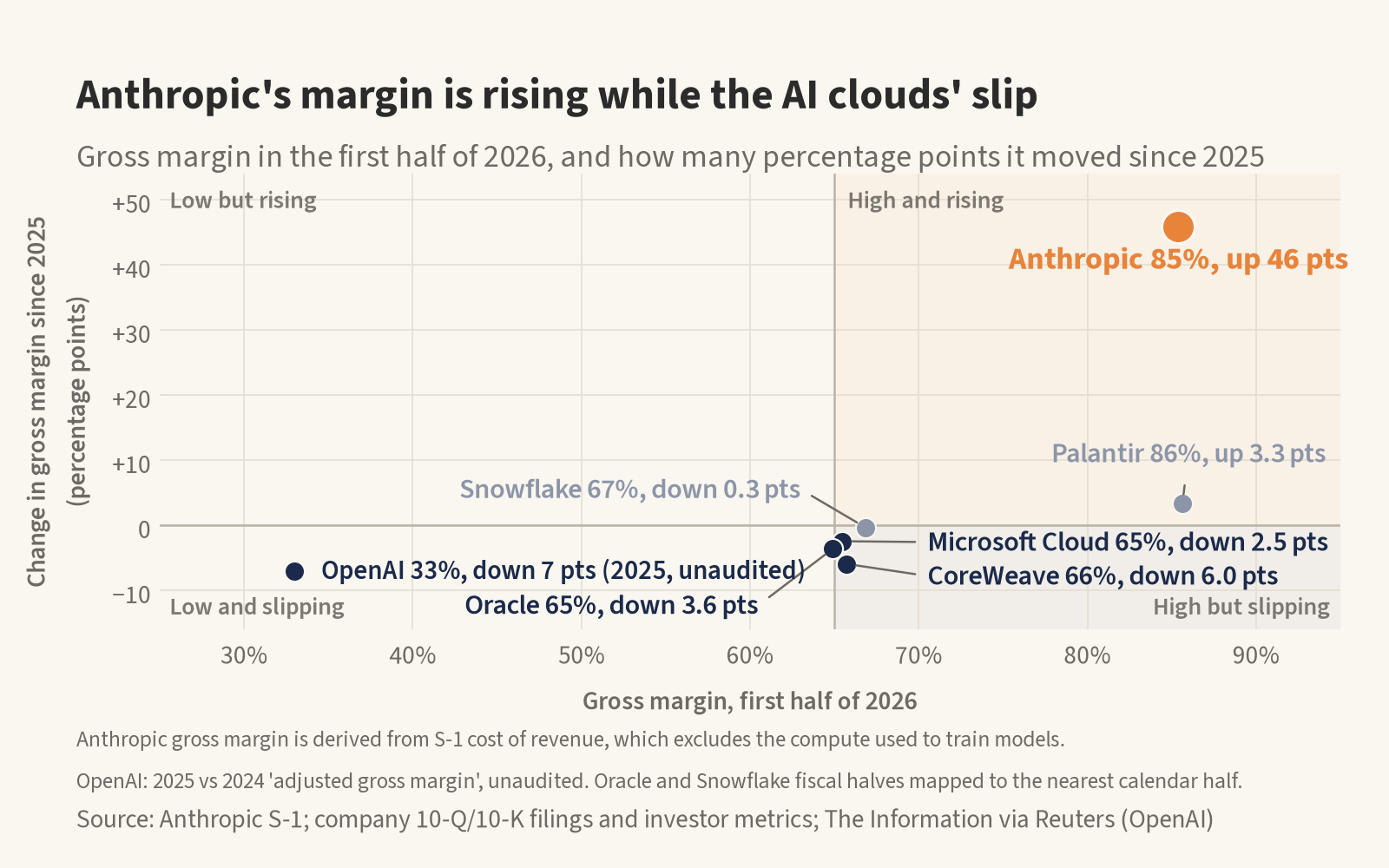
Serving those customers has also become far more profitable. The prospectus figures give a gross margin of 39.5% in 2025 and 85% in the first half of 2026. What is surprising is that the cloud companies renting out AI computing saw their margins slip over the same period. Anthropic pays for computing power a year or more ahead on fixed contracts, and in the first half revenue grew about 14 times while compute spending grew about 3.8 times.
That margin counts only the computing used to serve paying customers. Training is booked as research, and because over 80% of revenue comes from models released in the past six months, training is really a running cost. Counting all of its compute, Anthropic kept about 45% of its revenue in the first half. In 2025 it spent 160% of its revenue on compute.
The prospectus also shows a net loss of $80.7bn for the first half of 2026. Most of it costs no cash. Of that loss, $72.4bn is a charge on convertible notes, loans from Amazon's early investments that turn into shares instead of being repaid. They convert at $2.09 and $5.05 a share, against $58.90 in the Series H round in May, so their value rises with Anthropic's. By June they were worth about $108.6bn. The charge records the value handed to Amazon, which will own roughly 11% of the company once the notes convert. In the same period the business brought in $3.9bn of cash from operations.
The bigger risk is how quickly customers move to the newest model. Over 80% of third-quarter revenue came from models released in the previous six months. Customers would move just as fast to a better model from a rival. Little holds them in place. About 80% of revenue is pay-as-you-go, and the cloud marketplaces that bring in 48% of revenue sell rival models on the same bill. Market share has already swung. On Ramp, Anthropic's share of business spending on AI models jumped nine points in one month. In 2023 OpenAI had 50% of enterprise spending on models and Anthropic 12%. By late 2025, Menlo Ventures put Anthropic at 40% and OpenAI at 27%.
Anthropic's costs, by contrast, are mostly fixed. It has committed to about $637bn of computing over roughly the next decade, $269bn of it as firm minimums owed to Google, Amazon and Microsoft. They fall due whatever happens to revenue, and growth is already slowing. Revenue rose 144% from the first quarter to the second and about 45% from the second to the third, according to CNBC.
The Wall Street Journal reports that Anthropic is aiming to list at $1.5tn to $2tn. Against its third-quarter revenue rate, $1.5tn is about 22 times revenue and $2tn about 30 times. Microsoft trades at about 11 times its revenue and Nvidia at about 16. Palantir, at about 70 times, shows how much investors will pay for growth they trust.
At $1.5tn the price looks reasonable for a company that built a business the size of Oracle in five years and now brings in cash. At $2tn it assumes growth slows only gently while the compute bills arrive on schedule. That leaves little room for error, and it depends on the first public quarters showing where growth settles.